

USMNT vs Belgium at the 2026 FIFA World Cup: Preview, Key Battles, Predictions & Tactical Analysis
Explore a complete preview of a potential USMNT vs Belgium clash at the 2026 FIFA World Cup, including tactical analysis, key players, home advantage, and match predictions.
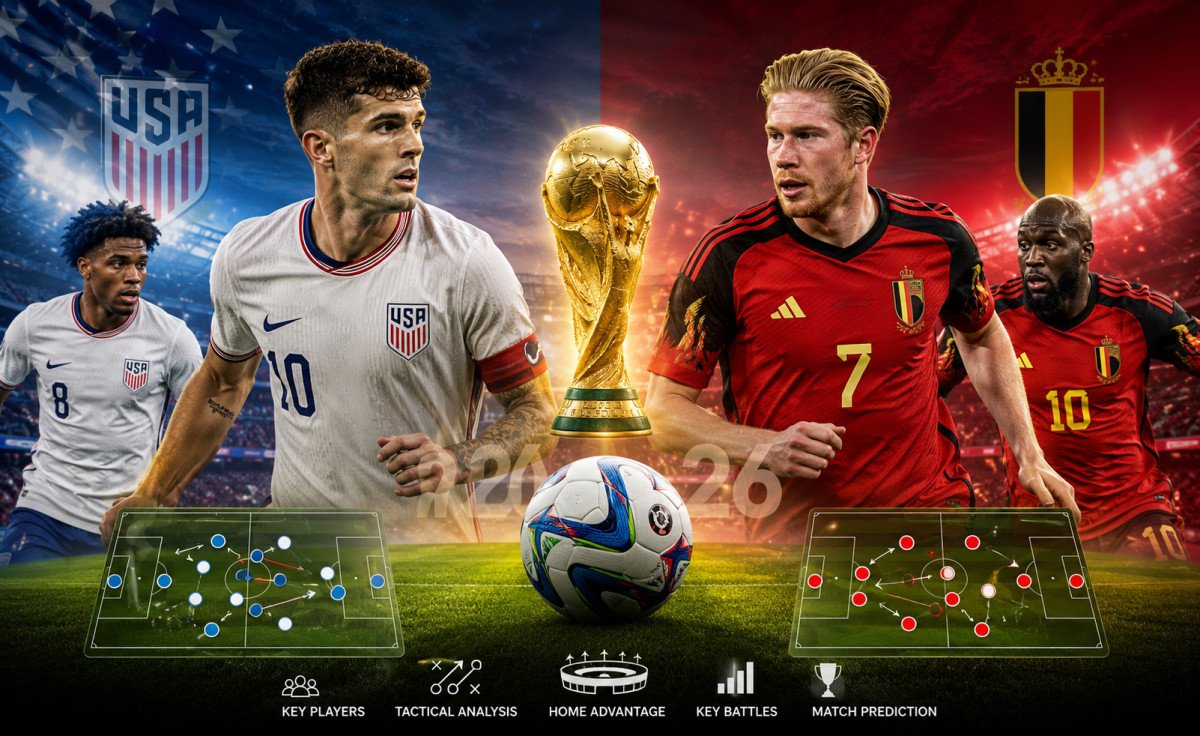
The possibility of the United States Men's National Team (USMNT) facing Belgium at the 2026 FIFA World Cup is enough to excite football fans around the world. Although the official tournament draw has not yet been announced, many supporters are already imagining what this matchup could look like. If it happens, it would be far more than just another World Cup fixture—it would be a chance for the United States to measure its progress against one of Europe's most respected football nations.
For American fans, the memories of the 2014 FIFA World Cup are still fresh. In the Round of 16, the United States pushed Belgium to its limits before eventually losing 2–1 after extra time. Goalkeeper Tim Howard produced one of the greatest performances in World Cup history, making an incredible 16 saves that kept the Americans in the match for as long as possible. Although Belgium advanced, the game earned worldwide respect for the fighting spirit shown by the USMNT.
More than a decade later, both teams have changed dramatically. New generations of players have emerged, coaching philosophies have evolved, and expectations are higher than ever. If these two nations meet in 2026, fans could witness one of the tournament's most fascinating tactical battles.
Looking Back at the Memorable 2014 Clash
The 2014 meeting between the United States and Belgium remains one of the most memorable knockout matches in recent World Cup history.
Belgium entered that tournament with a squad packed with rising stars. Players like Eden Hazard, Kevin De Bruyne, Romelu Lukaku, and Thibaut Courtois represented what many considered Belgium's "Golden Generation." Their technical quality made them one of the tournament favorites.
The United States, on the other hand, relied on discipline, teamwork, and determination. Tim Howard's legendary performance frustrated Belgium for most of the match, but eventually Belgium's attacking quality proved decisive in extra time.
Even though the United States was eliminated, the performance showed that the team could compete with elite opponents when organized and committed.
That match also became an important milestone for American soccer, inspiring a new generation of players who now form the core of today's national team.
A Different USMNT in 2026
The United States entering the 2026 FIFA World Cup looks very different from the squad that played in Brazil.
Today's American players have significantly more experience at the highest levels of European football. Many compete every week in top leagues such as the Premier League, Serie A, Bundesliga, and other major competitions. This exposure has improved both their technical ability and tactical understanding.
Players like Christian Pulisic, Weston McKennie, Tyler Adams, and several emerging young stars have helped raise expectations for the national team. Rather than simply hoping to compete, the goal is now to challenge the world's strongest teams and make a deep run in the tournament.
One noticeable change is the team's confidence with the ball. Previous American squads often focused on defending and counterattacking. The current generation is much more comfortable maintaining possession, building attacks patiently, and pressing opponents higher up the field.
This evolution makes the USMNT a far more balanced team than it was a decade ago.
Belgium Begins a New Chapter
Belgium has also undergone major changes since its famous Golden Generation reached its peak.
Many of the players who carried the national team through multiple major tournaments have retired from international football or moved beyond their prime years. Rather than relying on established superstars, Belgium is building another talented squad filled with promising young players.
Although the new team may not yet have the same global reputation, Belgium continues to produce technically gifted footballers through one of Europe's strongest youth development systems.
The country's emphasis on intelligent movement, quick passing, and tactical organization remains unchanged. Belgium's coaching philosophy continues to prioritize flexibility, allowing players to adapt to different formations depending on the opponent.
This rebuilding phase may actually make Belgium more unpredictable, as opponents have fewer established patterns to study.
Midfield Could Decide Everything
If the United States and Belgium meet in 2026, the midfield battle may ultimately determine the winner.
Modern football is often won in central areas where teams fight for possession, control the tempo, and launch attacks.
The American midfield combines athleticism, defensive intensity, and increasing technical quality. Tyler Adams brings leadership and defensive stability, Weston McKennie contributes physicality and box-to-box energy, while Christian Pulisic often creates opportunities between defensive lines.
Belgium traditionally relies on technically gifted midfielders who excel at controlling possession and finding creative passing angles.
Whichever team dominates this area of the pitch will likely enjoy more scoring opportunities and greater control over the match.
The Battle on the Wings
Wide areas have become increasingly important in modern football.
Both teams rely heavily on attacking full-backs and quick wingers to stretch opposing defenses.
For the United States, the full-backs must strike a careful balance between supporting attacks and preventing Belgian counterattacks.
If they push forward too aggressively, Belgium's pace on the break could create dangerous one-on-one situations.
At the same time, sitting too deep would reduce the attacking support available to American forwards.
Belgium faces a similar challenge, as the United States has become much more dangerous in transition than previous generations.
Winning the battles along the sidelines could have a major impact on the final result.
Transition Play Will Be Critical
One of the most exciting aspects of this potential matchup is how both teams perform during transitions.
Modern football often rewards teams that react fastest after losing or winning possession.
The United States has improved significantly in pressing opponents immediately after turnovers.
Belgium, meanwhile, has built a reputation for punishing defensive mistakes with quick, well-organized counterattacks.
The team that manages these transition moments more effectively may gain the decisive advantage.
Small mistakes in these situations can quickly turn into scoring opportunities at the World Cup level.
Will Home Advantage Help the United States?
One of the biggest talking points surrounding the 2026 FIFA World Cup is that the United States will be one of the host nations. Playing in front of home fans can provide an emotional boost that few teams enjoy on the world's biggest stage.
Packed stadiums, familiar surroundings, and overwhelming crowd support often help players perform with greater confidence. Fans can lift a team's energy during difficult moments, especially when defending a narrow lead or chasing an equalizer.
However, home advantage also comes with pressure.
Expectations from millions of supporters can become overwhelming if players focus too much on the occasion instead of the game itself. The coaching staff will need to ensure the squad remains calm, disciplined, and committed to its tactical plan.
If the United States manages the pressure well, playing at home could become one of its greatest strengths throughout the tournament.
Squad Depth Could Make the Difference
World Cups are rarely won by a starting eleven alone.
Successful teams usually rely on strong squad depth, especially during the knockout rounds when matches become increasingly demanding.
Fortunately, both the United States and Belgium have invested heavily in youth development over the past decade.
The USMNT now has a larger pool of players competing in Europe's top leagues than ever before. This gives the coaching staff more flexibility to adjust tactics based on the opponent or match situation.
Belgium also continues to produce technically gifted players capable of stepping into important roles. Even after the departure of many stars from its famous Golden Generation, the country's development system remains one of the best in Europe.
Impact substitutes could become game changers. A fresh winger against tired defenders, a creative midfielder chasing a goal, or an experienced defender protecting a narrow lead can completely change the outcome of a World Cup match.
Coaching Will Be Just as Important as Individual Talent
Major international tournaments are often decided by tactical decisions rather than individual brilliance alone.
Managers have only a limited amount of time to prepare their national teams compared to club football. As a result, every tactical adjustment becomes even more important.
The United States will likely focus on organized pressing, quick transitions, and using the pace of its attacking players to stretch Belgium's defense.
Belgium, meanwhile, may look to dominate possession, patiently build attacks, and exploit spaces left behind when the United States commits players forward.
The coaching battle could become just as fascinating as the contest between the players on the pitch.
A well-timed substitution, a formation change, or an adjustment at halftime could completely shift the momentum of the match.
Players Who Could Decide the Game
Big matches often produce unforgettable individual performances.
For the United States, experienced leaders such as Christian Pulisic, Weston McKennie, and Tyler Adams will likely carry much of the responsibility. Their ability to remain calm under pressure and inspire teammates could prove invaluable.
Belgium's emerging stars will also be eager to establish themselves on the world stage. Young players often use the World Cup as an opportunity to announce their arrival among football's elite.
Goalkeepers could also play a decisive role.
As fans remember from Tim Howard's unforgettable display in 2014, a world-class performance between the posts can completely change the course of a knockout match.
Whether through spectacular saves, confident distribution, or commanding the penalty area, the goalkeeper may once again become one of the game's biggest talking points.
What Could the Match Look Like?
If these teams eventually meet, several scenarios are possible.
If the United States scores early, the home crowd could create an incredible atmosphere that pushes the team forward. Belgium would then need to remain patient while searching for an equalizer.
On the other hand, if Belgium takes the lead first, its tactical discipline and experience could make breaking down its defense extremely difficult.
Another realistic possibility is a closely contested match decided by a single moment of brilliance, a defensive mistake, or even a penalty shootout.
Given the quality of both squads, football fans should expect an intense, competitive contest rather than a one-sided affair.
Why This Match Would Matter Beyond the Scoreline
A potential meeting between the United States and Belgium would represent more than just another World Cup fixture.
For the United States, it would be another opportunity to demonstrate how far its football program has progressed over the past decade. American soccer has invested heavily in youth development, professional leagues, and international experience, and the 2026 World Cup offers the perfect stage to showcase those improvements.
For Belgium, the match would highlight the success of its transition into a new generation of players. Maintaining competitiveness after the end of a Golden Generation is never easy, but Belgium continues to prove that its football system is built for long-term success rather than relying on a handful of stars.
Regardless of the outcome, the game would symbolize two national teams following different paths toward the same goal—competing with the world's very best.
Final Thoughts
Although a USA vs. Belgium match at the 2026 FIFA World Cup remains a possibility rather than a confirmed fixture, it is easy to understand why football fans are excited about the idea.
The history between the two nations, the evolution of both squads, and the tactical contrasts would make for an entertaining and meaningful contest.
The United States enters the tournament with growing confidence, talented players, and the advantage of playing on home soil. Belgium continues to rebuild while maintaining the technical quality and tactical intelligence that have made it one of Europe's strongest football nations.
If the draw brings these teams together once again, supporters can expect a fast-paced, hard-fought match filled with skill, intensity, and unforgettable moments. Whether it ends in regulation time, extra time, or penalties, another chapter in the USA–Belgium World Cup story would be well worth watching.
What's Your Reaction?
 Like
0
Like
0
 Dislike
0
Dislike
0
 Love
0
Love
0
 Funny
0
Funny
0
 Wow
0
Wow
0
 Sad
0
Sad
0
 Angry
0
Angry
0

We focus on content that stays useful over time. Instead of chasing short-lived trends, we create evergreen articles, guides, tips, and educational resources designed to deliver long-term value. Our team works to ensure every article is clear, reliable, and helpful for readers seeking trustworthy information online











Comments (0)